
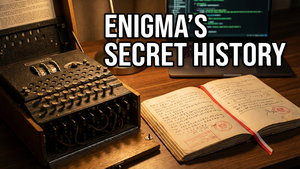
Cryptology Day: Celebrating Poland's Cryptological Legacy
Every January 25th, Poland celebrates Dzień Kryptologii (Cryptology Day) – a commemoration of one of the most significant achievements in the country's scientific history. This day honors the brilliant Polish mathematicians who accomplished what many thought impossible: breaking the German Enigma machine cipher. Their groundbreaking work not only showcased Polish scientific excellence but also significantly altered the course of World War II, potentially saving millions of lives. The three Polish heroes of cryptology: Marian Rejewski, Jerzy Różycki, and Henryk Zygalski
Origin and Significance of Cryptology Day
Dzień Kryptologii was established in 2007 by the Faculty of Mathematics and Computer Science at Adam Mickiewicz University in Poznań. The date marks the 75th anniversary of a remarkable achievement: on December 1932, Polish mathematicians successfully broke the code of the German Enigma machine – a feat that British and French intelligence services had deemed impossible.
This day serves as a tribute to Marian Rejewski, Jerzy Różycki, and Henryk Zygalski – three brilliant mathematicians and graduates of Adam Mickiewicz University who worked at the Polish Cipher Bureau. Their groundbreaking work laid the foundation for the Allied cryptanalysis efforts during World War II.
The significance of Dzień Kryptologii extends beyond honoring these three individuals. It celebrates Poland's broader contributions to the field of cryptology and raises awareness about the importance of this discipline in both historical and contemporary contexts.
The work of Polish cryptologists shortened World War II by several years, potentially saving millions of lives. Their achievement stands as one of the most significant Polish scientific contributions to Allied victory.
Breaking the Enigma: The Polish Achievement
The Enigma machine was an electromechanical device used by German military and government services to encrypt their communications. Its complexity made it seemingly unbreakable – the machine could be configured in billions of different ways, with each configuration creating a different cipher.

The German Enigma machine – a complex encryption device that changed military communication
In late 1932, Marian Rejewski made the crucial breakthrough. Using mathematical theory and materials provided by French intelligence, he reconstructed the internal wiring of the Enigma machine. This achievement allowed the Polish Cipher Bureau to read German encrypted messages between 1933 and 1939.
As war approached and German encryption methods became more complex, the Polish cryptologists developed innovative tools to continue breaking Enigma codes:
In July 1939, with war imminent, Polish intelligence shared their knowledge of Enigma with French and British allies. This transfer of knowledge became crucial for Allied cryptanalysis efforts at Bletchley Park in England, where Alan Turing and others built upon the Polish work to continue breaking increasingly complex German codes throughout the war.
The Polish contribution to breaking Enigma remained largely unknown to the public until the 1970s. The full recognition of their achievement by British intelligence only came officially in 1999 – decades after the war ended.
How Cryptology Day Is Celebrated
Cryptology Day has become an important date in Poland's academic and scientific calendar. The celebrations typically include:
- Special lectures at universities, particularly at Adam Mickiewicz University in Poznań
- Wreath-laying ceremonies at the monument to Polish cryptologists in Poznań
- Educational exhibitions about cryptology and the Enigma machine
- Workshops on modern cryptography for students
- Academic conferences bringing together cryptology experts
A particularly significant tradition is the annual cryptology lecture series at the Faculty of Mathematics and Computer Science. These lectures, inaugurated on January 25, 2008, feature renowned international experts in mathematics, computer science, and cryptology.
Visit the Enigma Cipher Center in Poznań
Experience the fascinating history of Polish cryptologists and see original Enigma machines at the interactive Enigma Cipher Center in Poznań.
Plan Your VisitCryptology in the Modern Digital Age
While Dzień Kryptologii commemorates historical achievements, it also highlights the continuing importance of cryptology in our digital world. Today, cryptography is fundamental to:
Cybersecurity
Protecting sensitive data from unauthorized access through encryption protocols
Digital Privacy
Ensuring confidential communications and personal information remain private

Blockchain Technology
Securing transactions and digital assets through cryptographic verification
Polish universities continue to excel in cryptology research, building upon the legacy of Rejewski, Różycki, and Zygalski. Many Polish mathematicians and computer scientists are at the forefront of developing new encryption methods and cybersecurity solutions.
Poland hosts several international cryptology conferences each year, attracting experts from around the world to discuss advancements in the field and honor the country's cryptological heritage.
Educational Impact of Dzień Kryptologii
One of the most valuable aspects of Cryptology Day is its role in inspiring young Poles to pursue studies in mathematics, computer science, and cybersecurity. The story of the three Polish mathematicians serves as a powerful example of how theoretical knowledge can have profound real-world applications.
Educational institutions across Poland use this day to organize:
- Cryptology competitions for students
- Interactive workshops on code-breaking
- Exhibitions about the history and future of encryption
- Special curriculum materials about Polish cryptologists
- Career information sessions about modern cryptology
- Coding clubs focused on security programming
Explore Cryptology Resources
Discover educational materials, online courses, and interactive tools to learn more about cryptology and its applications.
Start LearningThe Broader Historical Context
The achievements celebrated on Dzień Kryptologii represent just one chapter in Poland's rich history of mathematical excellence and resistance during World War II. Before the famous trio of Enigma codebreakers, Poland had already established a tradition of cryptological expertise.
Lieutenant Jan Kowalewski, another Polish cryptologist, had earlier broken Soviet military codes during the Polish-Soviet War (1919-1921). His work allowed Poland to intercept and decrypt Red Army communications, contributing significantly to Polish victory in that conflict.
The Polish Underground State during World War II continued this tradition, maintaining sophisticated intelligence networks that relied on encryption to protect communications between resistance cells and the Polish government-in-exile.
The story of Polish cryptology is not just about mathematical brilliance but also about patriotism and the determination to defend national independence through intellectual means.
The Enduring Legacy of Polish Cryptologists
Dzień Kryptologii serves as an annual reminder of how intellectual courage and mathematical ingenuity can change the course of history. The work of Rejewski, Różycki, and Zygalski represents one of Poland's greatest contributions to the Allied victory in World War II.
Their legacy lives on not only in the annual celebrations but also in Poland's continuing excellence in mathematics, computer science, and cryptography. Modern Polish universities and research institutions maintain strong programs in these fields, producing new generations of experts who build upon the foundation laid by their distinguished predecessors.
As we mark Dzień Kryptologii each January 25th, we celebrate not just historical achievements but also the continuing importance of cryptology in protecting our digital world. The story of the Polish codebreakers reminds us that mathematics and computer science are not just abstract disciplines but powerful tools that can shape the destiny of nations.
Join Cryptology Day Events
Participate in lectures, workshops, and exhibitions held across Poland to celebrate Cryptology Day and learn about this fascinating field.
- Szczegóły
- Autor: Jacek Szymanik
- Kategoria: Informacje
- Odsłon: 22696

